SRH Law – Saunders | Raubvogel | HandSRH Law – Saunders | Raubvogel | Hand

Making a difference is our practice.

  • Our Difference
  • Practice Areas
  • Our Team
  •  
  • Careers
  • Contact Us
  • News

Attorney Paul Quackenbush joins the Vermont Environmental Consortium

SRH Law is excited to announce that Attorney Paul Quackenbush has been elected to the Vermont Environmental Consortium (VEC) Board of Directors. Paul joins a group of environmental, political, engineering, legal, and other volunteers working to promote growth and economic development in Vermont’s environmental business sector.

VEC is involved in legislative advocacy, completing collaborative projects that support or grow environmental business fields, organizing conferences to explore current hot topics, and holding networking events.  Partner Geoff Hand has served on the Board since 2014 and is stepping down from the role as Paul gets started.

Paul focuses his practice on energy, environmental and land-use law, and  looking forward to working with VEC in his new Board  role.

If you are interested in learning more about our energy, environmental, or land use practices, please contact Paul Quackenbush and Geoff Hand.

Facebooktwitterlinkedin

Beneficial Ownership Information Reporting Now Required Under Corporate Transparency Act

Effective January 1, 2024, many corporations, limited liability company, limited partnerships and other types of legal entities are required by law to report certain information to the U.S. Department of Treasury’s Financial Crimes Enforcement Network (“FinCEN”). The Beneficial Ownership Information Reporting Rule (the “Reporting Rule”), adopted to implement the 2021 Corporate Transparency Act, is very broad in applicability and applies to many small businesses (including most single-member limited liability companies and holding companies). The Reporting Rule applies both to companies that were already in existence as of January 1, 2024, as well as companies formed on or after that date. A company that is subject to the Reporting Rule must report to FinCEN certain information about itself, its “beneficial owners” (i.e., the individuals who ultimately own or control the company), and, if the company was formed on or after January 1, 2024, its “company applicants.”

FinCEN has created a Frequently Asked Questions publication to help explain the Reporting Rule, as well as a Small Entity Compliance Guide. Here are some key excerpts from the FinCEN FAQ, as last updated on January 12, 2024:

General Questions:

Why do companies have to report beneficial ownership information to the U.S Department of the Treasury?
In 2021, Congress passed the Corporate Transparency Act on a bipartisan basis. This law creates a new beneficial ownership information reporting requirement as part of the U.S. government’s efforts to make it harder for bad actors to hide or benefit from their ill-gotten gains through shell companies or other opaque ownership structures.

What companies will be required to report beneficial ownership information to FinCEN?
Companies required to report are called reporting companies. There are two types of reporting companies:

  • Domestic reporting companies are corporations, limited liability companies, and any other entities created by the filing of a document with a secretary of state or any similar office in the United States.
  • Foreign reporting companies are entities (including corporations and limited liability companies) formed under the law of a foreign country that have registered to do business in the United States by the filing of a document with a secretary of state or any similar office.

Are some companies exempt from the reporting requirement?
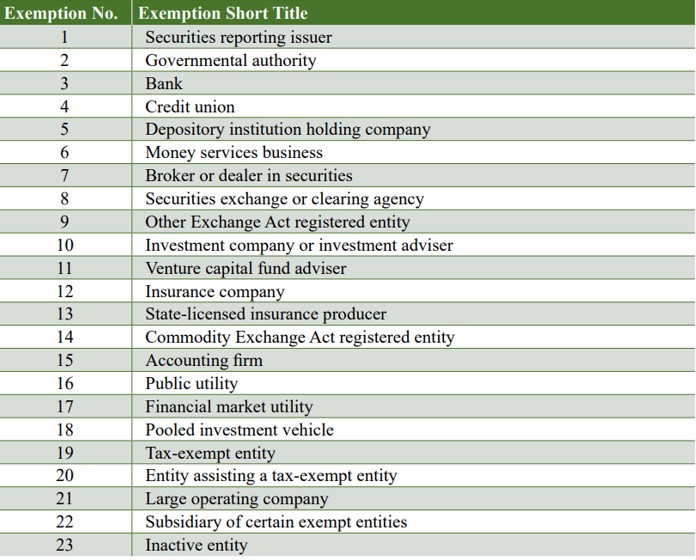
Yes, 23 types of entities are exempt from the beneficial ownership information reporting requirements. These entities include publicly traded companies meeting specified requirements, many nonprofits, and certain large operating companies.

The following table summarizes the 23 exemptions:

How does a company report to FinCEN that the company is exempt?
A company does not need to report to FinCEN that it is exempt from the beneficial ownership information reporting requirements if it has always been exempt.
If a company filed a beneficial ownership information report and later qualifies for an exemption, that company should file an updated beneficial ownership information report to indicate that it is newly exempt from the reporting requirements. Updated beneficial ownership information reports are filed electronically though the secure filing system. An updated beneficial ownership information report for a newly exempt entity will only require that the entity: (1) identify itself; and (2) check a box noting its newly exempt status.

Reporting Process

When are the filings due?

  • Any reporting company created or registered to do business before January 1, 2024 will have until January 1, 2025 to file its initial beneficial ownership information report.
  • A reporting company created or registered in 2024 will have 90 calendar days to file after receiving actual or public notice that its creation or registration is effective.
  • A recording company created or registered on or after January 1, 2025 will have 30 calendar days to file to file after receiving actual or public notice that its creation or registration is effective.

Will there be a fee for submitting a beneficial ownership information report to FinCEN?
No. There is no fee for submitting your beneficial ownership information report to FinCEN.

Is there a requirement to annually report beneficial ownership information?
No. There is no annual reporting requirement. Reporting companies must file an initial beneficial ownership information report and updated or corrected beneficial ownership information reports as needed.

Can a parent company file a single beneficial ownership information report on behalf of its group of companies?
No. Any company that meets the definition of a reporting company and is not exempt is required to file its own beneficial ownership information report.

What should I do if previously reported information changes?
If there is any change to the required information about your company or its beneficial owners in a beneficial ownership information report that your company filed, your company must file an updated report no later than 30 days after the date of the change.
A reporting company is not required to file an updated report for any changes to previously reported information about a company applicant.

What should I do if I learn of an inaccuracy in a report?
If a beneficial ownership information report is inaccurate, your company must correct it no later than 30 days after the date your company became aware of the inaccuracy or had reason to know of it. This includes any inaccuracy in the required information provided about your company, its beneficial owners, or its company applicants.

Where can I find the form to report?
Access the form by going to FinCEN’s beneficial ownership information E-Filing website (https://boiefiling.fincen.gov) and select “File BOIR.”

Information to Report

What information will a reporting company have to report about itself?
A reporting company will have to report:

  • Its legal name;
  • Any trade names, “doing business as” (d/b/a), or “trading as” (t/a) names;
  • The current street address of its principal place of business if that address is in the United States (for example, a U.S. reporting company’s headquarters), or, for reporting companies whose principal place of business is outside the United States, the current address from which the company conducts business in the United States (for example, a foreign reporting company’s U.S. headquarters);
  • Its jurisdiction of formation or registration; and
  • Its Taxpayer Identification Number (or, if a foreign reporting company has not been issued a TIN, a tax identification number issued by a foreign jurisdiction and the name of the jurisdiction).

A reporting company will also have to indicate whether it is filing an initial report, or a correction or an update of a prior report.

What information will a reporting company have to report about its beneficial owners?
For each individual who is a beneficial owner, a reporting company will have to provide:

  • The individual’s name;
  • Date of birth;
  • Residential address; and
  • An identifying number from an acceptable identification document such as a passport or U.S. driver’s license, and the name of the issuing state or jurisdiction of identification document.

The reporting company will also have to report an image of the identification document used to obtain the identifying number in item 4.

Who is a beneficial owner of a reporting company?
A beneficial owner is an individual who either directly or indirectly: (1) exercises “substantial control” over the reporting company, or (2) owns or controls at least 25% of the reporting company’s ownership interests.

What is substantial control?
An individual can exercise substantial control over a reporting company in four different ways. If the individual falls into any of the categories below, the individual is exercising substantial control:

  • The individual is a senior officer (the company’s president, chief financial officer, general counsel, chief executive office, chief operating officer, or any other officer who performs a similar function).
  • The individual has authority to appoint or remove certain officers or a majority of directors (or similar body) of the reporting company.
  • The individual is an important decision-maker for the reporting company.
  • The individual has any other form of substantial control over the reporting company as explained further in FinCEN’s Small Entity Compliance Guide.

Will a reporting company need to report any other information in addition to information about its beneficial owners?
Yes. The information that needs to be reported, however, depends on when the company was created or registered.

  • If a reporting company is created or registered on or after January 1, 2024, the reporting company will need to report information about itself, its beneficial owners, and its company applicants.
  • If a reporting company was created or registered before January 1, 2024, the reporting company only needs to provide information about itself and its beneficial owners. The reporting company does not need to provide information about its company applicants.

Who is a company applicant of a reporting company?
Only reporting companies created or registered on or after January 1, 2024, will need to report their company applicants.
A company that must report its company applicants will have only up to two individuals who could qualify as company applicants:

  • The individual who directly files the document that creates or registers the company; and
  • If more than one person is involved in the filing, the individual who is primarily responsible for directing or controlling the filing.

What information will a reporting company have to report about its company applicants?
For each individual who is a company applicant, a reporting company will have to provide:

  • The individual’s name;
  • Date of birth;
  • Address; and
  • An identifying number from an acceptable identification document such as a passport or U.S. driver’s license, and the name of the issuing state or jurisdiction of identification document.

The reporting company will also have to report an image of the identification document used to obtain the identifying number in item 4.

What is a FinCEN identifier?
A “FinCEN identifier” is a unique identifying number that FinCEN will issue to an individual or reporting company upon request after the individual or reporting company provides certain information to FinCEN. An individual or reporting company may only receive one FinCEN identifier.

How can I use a FinCEN identifier?
When a beneficial owner or company applicant has obtained a FinCEN identifier, reporting companies may report the FinCEN identifier of that individual in the place of that individual’s otherwise required personal information on a beneficial ownership information report.

Penalties

What penalties do individuals face for violating beneficial ownership information reporting requirements?
As specified in the Corporate Transparency Act, a person who willfully violates the beneficial ownership information reporting requirements may be subject to civil penalties of up to $500 for each day that the violation continues. That person may also be subject to criminal penalties of up to two years imprisonment and a fine of up to $10,000. Potential violations include willfully failing to file a beneficial ownership information report, willfully filing false beneficial ownership information, or willfully failing to correct or update previously reported beneficial ownership information.

Is a reporting company responsible for ensuring the accuracy of the information that it reports to FinCEN, even if the reporting company obtains that information from another party?
Yes. It is the responsibility of the reporting company to identify its beneficial owners and company applicants, and to report those individuals to FinCEN. At the time the filing is made, each reporting company is required to certify that its report or application is true, correct, and complete. Accordingly, FinCEN expects that reporting companies will take care to verify the information they receive from their beneficial owners and company applicants before reporting it to FinCEN.

***

The above questions and answers consist solely of excerpts taken from the FinCEN FAQ, last updated on January 12, 2024. If you own or operate a reporting company, it is critical that you familiarize yourself with the Reporting Rule and your company’s obligations thereunder. We encourage you to read through the full FinCEN FAQ, as well as the FinCEN Small Entity Compliance Guide. Additional information, reference materials and guidance can be obtained from the FinCEN website. Please also feel free to contact Drew Kervick, Victoria Westgate or Megan Noonan with any questions about the Corporate Transparency Act or the Reporting Rule – we  would be happy to help.

Facebooktwitterlinkedin

SRH Law Sponsors Renewable Energy Vermont’s 2023 Annual Conference

SRH Law is proud to be a Megawatt sponsor of the 2023 Renewable Energy Vermont (REV) conference, held at DoubleTree Hilton in South Burlington, on October 18-19, 2023.

According to REV, the annual conference brings together a wide range of professionals from all major clean energy sectors—power, heat, transportation, and efficiency—including business leaders, system operators, attorneys, engineers, scientists, policy makers/regulators, architects, builders, and manufacturers.

SRH Law is sponsoring “The Latest Innovations in Battery Storage Systems” panel, which will cover advancements to energy storage management and technology.  We think this panel will be particularly timely and instructive, given the recent increase in proposed large scale battery systems in Vermont.

SRH Law partner Andy Raubvogel is a long time REV Board Member and will be attending REV2023 along with other SRH attorneys and staff.

You may sign up for the Conference here.  You can find more information regarding the Conference, sessions, and speakers here.

Facebooktwitterlinkedin

Champlain Housing Trust Receives $20 Million Donation from Philanthropist Mackenzie Scott

Champlain Housing Trust announced this week that they are the recipient of a $20 million donation from philanthropist Mackenzie Scott’s Yield Giving fund. 

This donation is the largest in the nonprofit’s 40-year history and will be used to build and preserve permanent affordable housing, support and increase access to homeownership, increase access for BIPOC households, address the homelessness crisis, and strengthen community in Chittenden, Franklin and Grand Isle counties. 

This donation can impact thousands of lives in Vermont, and we look forward to the good work Champlain Housing Trust will continue to do with this generous donation.  Congratulations to Champlain Housing Trust.

Facebooktwitterlinkedin

SRH Law Sponsors the Vermont Employee Ownership Conference

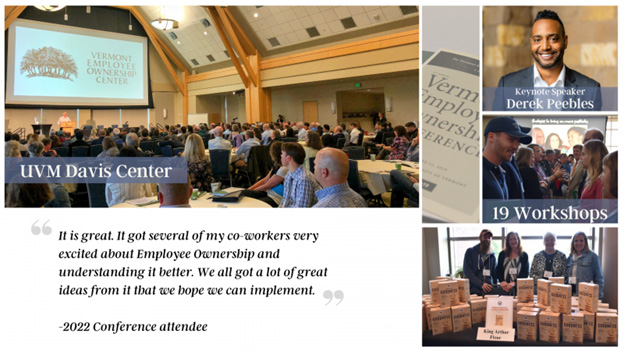
SRH Law is proud to announce our sponsorship of the 21st Annual Vermont Employee Ownership Conference, hosted by the Vermont Employee Ownership Center (“VEOC”).  Employee ownership is a transformative model that empowers workers by granting them a stake in the businesses they help build and sustain; it fosters a sense of shared responsibility, enhances job satisfaction, and strengthens the overall economic landscape.

This year’s conference will highlight: Transitioning to Employee Ownership, Employee Ownership Success Stories, Legal Considerations in Employee Ownership, and Financing and Sustainability.

As proud sponsors of the 21st Annual Vermont Employee Ownership Conference, SRH Law is dedicated to supporting the growth and success of employee-owned businesses.  Through our relationship with the VEOC, we celebrate the power of employee ownership and its positive impact on businesses, employees, and communities.

Join us at the VEOC conference June 1, 2023 at the Dudley H. Davis Center at the University of Vermont in Burlington by registering here.

Facebooktwitterlinkedin

VBSR 21st Annual Awards Ceremony

Attorneys and staff from SRH Law attended the Vermont Businesses for Social Responsibility’s (VBSR) 21st Annual Awards Ceremony at Basin Harbor on October 4, 2022 to celebrate the outstanding contributions of a select few members of the socially responsible business community.

VBSR is a statewide, nonprofit business association, whose mission is to foster a business ethic in Vermont that recognizes the opportunity and responsibility of the business community to set a high standard for protecting the natural, human, and economic environments of our citizens. SRH Law has been a proud member of this organization for many years and a sponsor of the event.

At this year’s awards ceremony, our client the Flexible Capital Fund, L3C received the Innovation and Inspiration Award for Small Organizations for its commitment to helping small and innovative growth-stage companies in the green economy stay and grow in Vermont. Congratulations to Janice St. Onge and her team for the much-deserved recognition!

The 2022 Terry Ehrich Lifetime Achievement Award was presented to Curtiss Reed, Jr., President of CRJ Consulting Group, L3C and Executive Director, Vermont Partnership for Fairness & Diversity for his work providing training and coaching on inclusion, bias, and equity, helping to make Vermont a desirable destination for all. In addition, Burlington-based Mamava won the VBSR Innovation and Inspiration Award for Large Organizations and Emiliano Void, CEO of nuwave Equity Corporation, won the Young Changemaker Award. Congratulations to all of this year’s awardees!

Facebooktwitterlinkedin

SRH Law Names Victoria Westgate Partner

Burlington, VT – SRH Law today announced that Victoria Westgate has been named a Partner of the Firm.  Vic is an experienced counselor who helps clients in a range of practice areas, including energy and environmental, advertising and consumer protection, and business law.

Vic joined the firm in 2014 after a clerkship with Justice Marilyn S. Skoglund of the Vermont Supreme Court.  Since then, Vic has built a diverse regulatory practice across a variety of areas, including renewable energy permitting, advertising and marketing claims, and nonprofit law.  Vic enjoys helping businesses tackle complex regulatory questions and finding solutions to compliance issues.

“We are extremely pleased to have Vic join the partnership, as it signifies our deep respect for her skills and creativity as a lawyer, and her commitment to the mission of the Firm,” said Andy Raubvogel, Managing Partner.

Vic lives in Burlington with her husband and two sons. When she’s not at work, you can probably find her chasing her kids around one of Burlington’s many playgrounds.

Facebooktwitterlinkedin

Vanguard Renewables Begins Operation of the Largest Renewable Natural Gas Biodigester in the Northeast

SRH Law congratulates its client, Vanguard Renewables, on the startup of its renewable natural gas biodigester at the Goodrich Family Farm in Salisbury, Vermont. The facility utilizes two 925,000-gallon biodigesters to convert 180 tons of food waste and 100 tons of manure every day into renewable natural gas, enough to heat 5,000 homes. Vanguard’s facility will assist the Goodrich Farm, Middlebury College and Vermont Gas in lessening their dependence on fossil fuels and reducing Vermont’s carbon footprint.

SRH Law is privileged to be a team member on this project, working closely with Vanguard to secure the necessary state permits including a Certificate of Public Good from the Vermont Public Utility Commission.

For more information about this project, read VT Digger’s article on the biodigester’s opening.

Facebooktwitterlinkedin

SRH Law Supports VBSR’s 31st Annual Conference

SRH Law is proud to support VSBR’s 31st Annual Conference, happening virtually on Thursday, May 20.  The conference will explore three themes:  Anti-Racism, Business Resiliency, and The Climate Crisis.  Register for this conference here.

SRH Law is sponsoring the workshop on “Carbon Reduction in Businesses Large and Small”.  Two experts – Austin Whitman of Climate Neutral and Cyrus Schenck of Renoun Skis – will provide professional input and share their experience, discussing strategies for businesses to make their contributions toward reducing greenhouse gas emissions.

You can find additional information on the VBSR 31st Annual Conference agenda here, and on the presenters here.

Facebooktwitterlinkedin

Hula completes transformation of Blodgett plant into creative co-working space

SRH Law congratulates client Hula LLC on the successful redevelopment of the Blodgett plant in Burlington’s South End. The 150,000 square-foot, single-story building complex at 50 Lakeside Avenue has been transformed into what Hula describes as a “collision space” for creatives, where the single-story design fosters connection among local entrepreneurs while they “co-work” together in the space. Hula has published an account of the lakeside tech campus from concept to construction—in the middle of a pandemic, no less—and the team of managers and designers that made it a reality, on its blog here.

The Hula lakeside tech campus is located in Burlington’s South End, a designated Opportunity Zone and the Enterprise Zoning District in Burlington’s PlanBTV land use guide. SRH Law assists clients with a variety of legal services pertinent to redevelopment projects like Hula’s, such as identifying and qualifying for tax incentives, navigating land use permitting on the state and municipal level, and tackling the process of environmental clean-up for projects proposed on former industrial sites.Facebooktwitterlinkedin

  • « Previous Page
  • 1
  • 2
  • 3
  • 4
  • …
  • 13
  • Next Page »

How can we help you make a difference?

Hiring an attorney is about finding someone you trust to advocate for you. We take our obligations to our clients seriously, and will do everything we can to help you succeed.

Contact Us »

Contact Us

91 College Street
PO Box 545
Burlington, VT 05402-0545


Email info@srhlaw.com

tel (802) 860-1003

fax (802) 860-1208

News

SRH Law Participates in the VT Corporate Cup

Alex Arroyo Joins SRH Law

SRH Law is pleased to welcome Malachi Brennan as its newest partner

Megan Grove to participate in Common Good Vermont’s Nonprofit Management Certificate Program

SRH Law Sponsors Inaugural Justice Gala & Legal Services Vermont’s 30th Anniversary

More News »

Connect with Us 

  • Facebook
  • Instagram
  • LinkedIn
  • Twitter
Careers at SRH Law
Make Secure Online Payment
Privacy Policy & Terms of use
 

SRH Law

Copyright © 2026 SRH Law – Website by Stride Creative • Log in